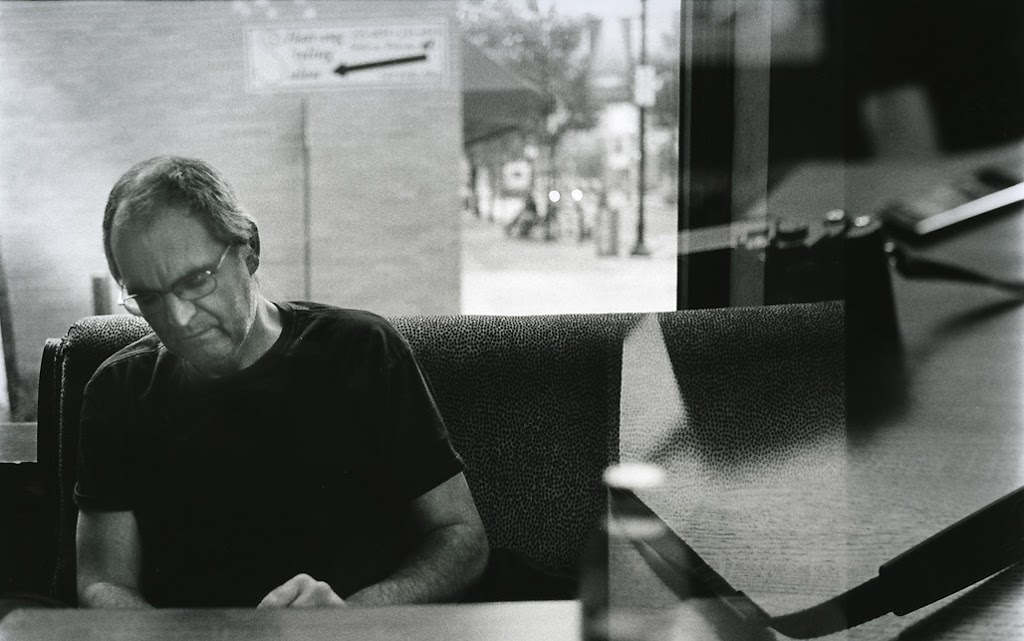
The Motorcycle Mechanic
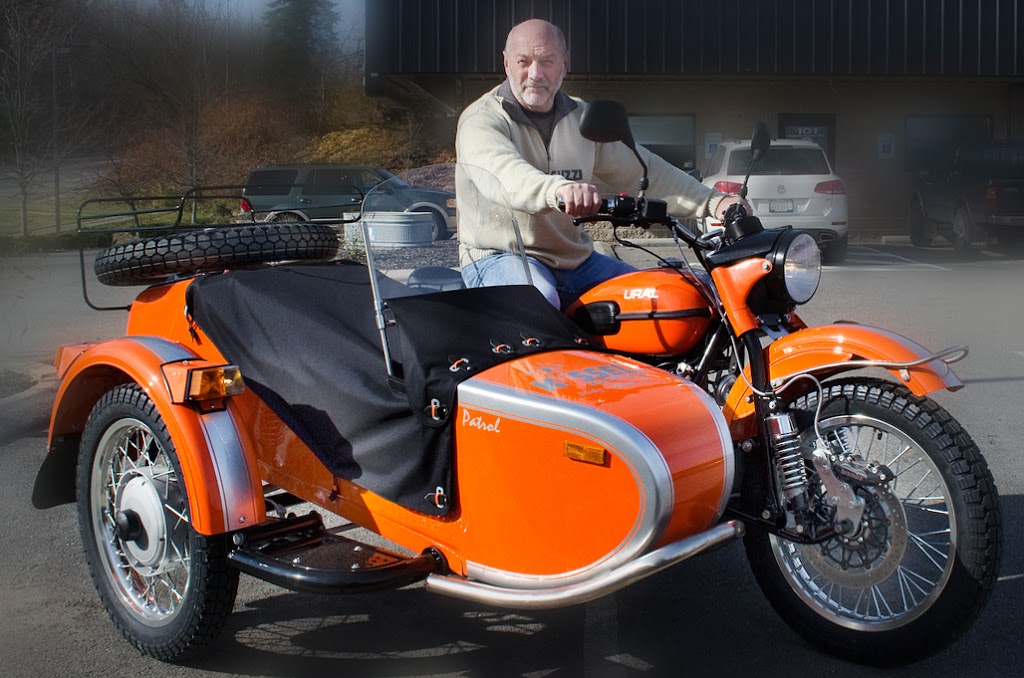
That’s Tom Christensen, motorcycle mechanic.
Whenever I leave my Vespa for service at Kissell Motorsports I didn’t really know what was happening to it or who was doing the work. The scooter would be left behind and then, as if by magic, it would be returned with whatever mechanical needs addressed. For some people that would be enough. I got it into my head that I wanted to know the people who were evaluating my machine, turning the wrenches, and actually working on the Vespa. Or maybe I had a desire to enter the Employees Only realm, pull the curtain aside, and become part of the secret world of motorcycle service. So I suggested to Craig Kissell that it would be a good idea for me to interview the technicians, put a human face on that part of his business. About six weeks ago I took a step over the line and told Tom that I was going to interview him.
Meeting your mechanic is sort of like going to the dentist. You know you have to go but you’re afraid of what he’s going to say. They have a special power of life and death over motorcycles and scooters and I treat them accordingly. Something short of a blood sacrifice. My friend Paul would offer a box of Dunkin Donuts. I completely drop the ball and show up with a camera and the voice recorder in my iPhone.
One thing I tell would be riders when asked the ago old question, “What kind of scooter or motorcycle should I buy?” is to buy something you can have serviced by a local mechanic. Everyone can define local in his or her own way. For instance, BMW riders feel a local mechanic is someone within a day’s ride. So about 1000 miles. My definition puts them a bit closer. Either way, make sure you have a mechanic who can work on your bike before you buy it.
Having a good mechanic means more time to ride and less time involved in transporting a bike around. No one needs to remind me about the notion of spare bikes.
So I’m talking to Tom, trying to act cool and knowledgeable and hoping he doesn’t remember my unfortunate attempt to change the drive belt on my LX150. Detecting no smirks I move ahead with the interview. He’s putting a new, high performance exhaust system on a shiny red Ducati.
STEVE: So, how did you become a mechanic?
TOM: Everyone in my family is a mechanic. I started when I was five years old. My brothers and dad taught me. That’s how I learned about engines and stuff. I went to the Motorcycle Mechanics Institute in Arizona to get the credentials.
(At this point I’ve run out of questions. Tom seems content and isn’t offering anything more. Just as I prepare to wind up the interview he continues.)
TOM: My dad’s blind. He’s the local lawn mower repairman and is pretty good at listening to engines and fixing them by what he hears.
STEVE: How does listening fit into motorcycle repair?
TOM: You feel things through listening. The sounds tell a story. I end up making a lot of motorcycle noises.
(He starts making some remarkably mechanical sounds.)
TOM: That’s a Ducati.
(I hear a couple snickers from other guys in the shop and wonder if I am about to be the punch line to a joke. Tom must have sensed my complete and utter mechanical incompetence and would believe anything he said.)
TOM: Like those guys on CarTalk, Click and Clack, they’re always asking people to make the noise their car is making.
(He makes another noise that sounds like a transmission problem.)
TOM: You can figure out a lot of things about a problem if you learn to listen carefully. It’s not all about computers. That’s where the passion comes in. For a mechanic to diagnose a problem he often needs to hear the sound, whether it’s a clank clank clank, a clunk clunk clunk or a boing boing boing. That’s where my noise making comes from.
(The other guys in the shop have stopped what they were doing as if something was about to happen when one of them tells me to ask him about Karl. Tom stops what he’s doing and his face transforms into another person, someone I recognize but can’t quite remember until he suddenly breaks into a perfect rendition of Karl Childers, the character made famous by Billie Bob Thornton in SlingBlade.)
TOM: I like them French fried potaters.
If you don’t know of Sling Blade check out the video below. The main character, Karl, is an engine expert, hence the connection to a mechanic:
(Everyone cracks as he continues. Standing in the shop I feel like I have entered a David Lynch film and look around for Frank Booth. After a couple minutes of Sling Blade I ask another question.)
STEVE: What’s the easiest bike to work on here?
TOM: A Triumph is probably the easiest bike to work on. Straightforward, simple, reliable engineering. But my favorite bike to work on is a Ducati. I love the sound, the feel, the passion that goes into their creation. Every nut and bolt and fastener is well thought out and engineered. Every connection and cable and wire is chosen with excellence in mind.
(He begins speaking in tongues.)
TOM: There’s nothing like the sound of a Ducati.
(He shows me the new exhaust he’s installing on a Ducati 1198S.)
TOM: These pipes are all hand made stainless steel.
STEVE: I think they’re the same diameter as the exhaust on my Ford Ranger.
TOM: Come on, let me show you something.
(We head across the shop and go outside. I’m trying to think how to segue from the Ducati to the Vespa as we stop in front of a Ducati 796 with a newly installed exhaust system. I can tell he’s passionate about motorcycles and what makes them tick.)
(Back in the shop I shift gears.)
STEVE: So, what should riders be thinking about now that’s its spring. What should they be doing to get ready to ride?
TOM: Well, other than checking the air in their tires they should have done everything last fall when they stored their bike for the winter. This time of year I’m busy with carb cleaning and spark plug changes because gas was left in the motorcycle over the winter and when they started it up things got fouled.
STEVE: What do you suggest?
TOM: If you did leave the gas in all winter it would be a good idea to drain the float bowl before you try and start the motorcycle. Because once you try and burn that bad gas, well….
(I’m still trying to move the conversation towards the Vespa when it dawns on me that maybe Tom rides one himself!)
STEVE: What do you ride?
TOM: I have a SuperMoto conversion bike, a Honda XR650R liquid cooled Baja bike. (To some this bike is known as the biggest, baddest dirt bike ever) I put on Supermoto wheels, made it road legal, custom suspension, new bars and bar ends, lowered the front…
(I’m wondering what he must think of the scooter I’m riding. Just outside the shop door are a lot of Ducati motorcycles. BMWs, Triumphs, and Vespa scooter too. Just in case you need one.)
TOM: It’s the bike I always wanted; I like the dual sport, moto bikes. Sometimes I wish I would have waited for the Hypermotard but the one I have is great. Light, flickable. A SuperMoto bike is ideal for the kind of back roads we have here in central Pennsylvania.
(He’s putting a muffler on the Ducati and I’m looking around, searching for a way to bring up the Vespa.)
TOM: I can’t believe how many miles you put on your Vespa. Not many people do that.
(As if by magic my spine has straightened. I think I hear trumpets echoing in the distance.)
STEVE: It’s a good machine. It’s been pretty reliable.
TOM: You make sure it’s serviced properly. That makes a big difference.
STEVE: Yeah. You guys do a good job with it.
(And that’s how we ended the interview.)
I got to finally talk with one of the mechanics at Kissell Motorsports for more than a minute or two. When I was riding the BMW R100 GS last week Tom personally checked it out and provided his assessment of the bike – a big thumbs up. When I returned it he seemed as surprised as everyone else that I was going to remain a scooter rider.
Some things defy human understanding.
Regardless, Tom can work on the Vespa anytime.
Who Rides to Work?
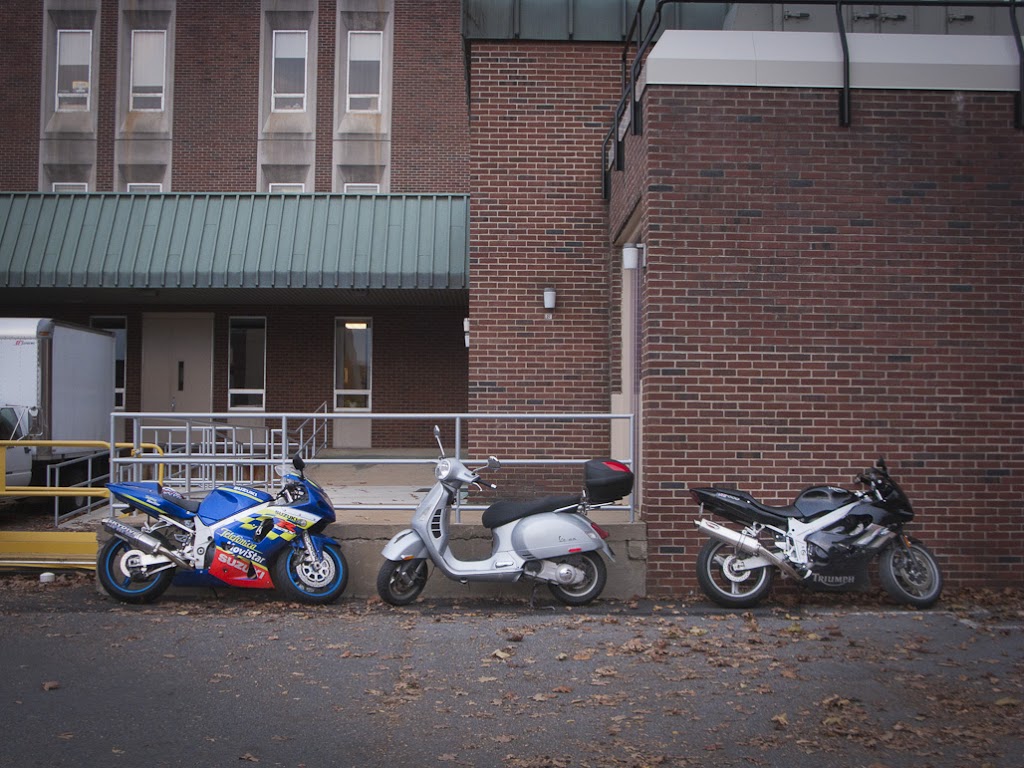
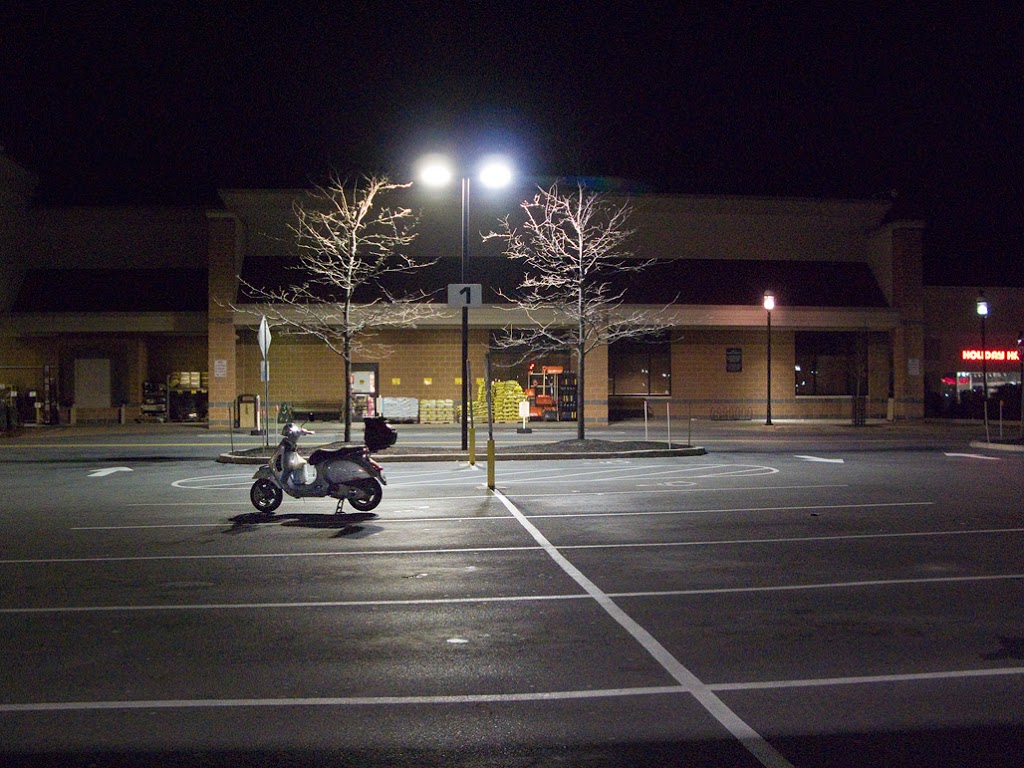
Can’t believe there are no motorcycles at work today. With the temperature near 50F I thought I would have trouble finding a parking space today. Once the days get warm only the early bird riders will find spaces here. Had to go look at my calendar to make sure there wasn’t some big riding event somewhere that I missed.
Who’s riding to work? Has the normal riding season started yet? Is it still too cold to ride?
Fat, Happy and Sitting in Front of the Computer
Yesterday evening I stopped to inspect the artillery pieces that would be part of some Civil War event at the Pennsylvania Military Museum today. The light was nice, drew out the Canon G9 to create the quintessential Civil War Vespa image only to find the SD card was absent from the camera. Luckily the iPhone was in my pocket so I was able to satisfy my photographic hunger at some level.
It was just starting to rain so I hurried home to the warmth and protection afforded by middle class living.
This morning Junior and I visited the men huddled under a tent awning trying to stay warm and dry. Weather makes friends of the worst enemies because I saw Union and Confederate soldiers in that group. I asked how they keep their powder dry and was told the cannon charges were inside plastic bags and then wrapped in aluminum foil. With aluminum foil not being invented until 1910 and who knows when the first plastic bag appeared I wanted to ask a question. But Junior insisted we move on to the ball throwing part of the day.
He remains impervious to the rain, wind, and creeping cold that these kind of days deliver.
Anyways, I have been getting a lot of grief lately about passing on that 1988 BMW R100 GS. Some of it from myself too. One thing that comes up over and over is the limited capabilities of the Vespa. Having put over 30 thousand miles on modern Vespa scooters I can find only two limiting factors:
1. It is impossible to ravage the speed limits on the Interstate highway system. Just not enough power.
2. Stream crossing ability is limited.
3. Riding over big obstacles is problematic.
Other than that you can pretty much go anywhere and do anything that time, money, and skill will allow. And I won’t go into the many other things a Vespa can accomplish that I don’t ever see anyone on motorcycles doing around here.
Whenever I hear the limitations argument I always think of Walter Muma, the fellow who rode his Honda moped from Detroit to Alaska and back — 11,500 miles. And he did it in 1978 when those Alaskan roads really were adventure territory.
I understand why people want big cushy bikes — it makes things easier and more comfortable. And it allows you to compress distance when you have limited time. And specific machines can enable to to pursue certain kinds of performance if that’s your goal.
Calgary photographer and Vespa rider Sergei Belski recently completed a 4400 mile trip on his GTS 250ie. Looks a lot like mine. And he travels light. Check out his site. He makes some nice riding pictures.
It’s stuff like this that makes me smile a bit when guys pigeonhole the scooter as an “around town” thing. It’s that kind of thought process that has them thinking a Harley 883 is a “girl’s” bike or that anything less that 1000cc is underpowered. Exactly how much do these guys weigh?
So, just sitting here, eating, wasting time, watching the rain come down, and waxing philosophically about riding and adventure. Hell, I should gear up and go for a ride. We’re only supposed to get another half inch of rain in the next hour or so.
How bad can it be? I’ve got those great German tires on the Vespa after all…
Decisions: The 1988 BMW R100 GS
A couple days after seeing my Consumption Therapy and Moto-Porn post Craig Kissell told me he would be taking a BMW R100 GS on trade and it would have my name on it should I want to buy it. It seemed as if the universe was conspiring to have me become an owner of a BMW. Who am I to argue with fate?
I took the afternoon off from work and despite the rain decided I would have to take the BMW (cover your ears Mr. Riepe) Airhead for a ride. It had already passed the visual test. All that was left was the road test.
After Kissell Motorsports mechanic Tom Christensen went over the bike and made sure it was ready for the road I left the Vespa and headed out in a light mist. The bike was, well, amazing. Started easily, idled perfectly, sounded amazing, and shifted with ease. Sales Manager Nate Mattern said the transmission had been rebuilt and the circlip and other issues corrected. You could tell it was ready to hit the road and ride for a long way. After some experimenting with the brakes and controls I stopped on Skytop Mountain to make a picture.
The two aluminum side cases were sturdy and functional — just like the rest of the motorcycle. I was completely impressed by the mechanical feel of the bike and the sense of purpose and capability. For a 1988 machine with 60K miles on it I would have thought I was riding a much newer motorcycle.
The BMW R100 GS is pretty. As a photographic subject I could make use of it on Scooter in the Sticks. It seemed like a natural partner for my Vespa and would lend itself to a new variety of riding. Or so I was trying to tell myself.
Standing near this church I wondered how often I would fill those sidecases and take a long trip. Or how often I would make use of the power and capabilities of the motorcycle. Didn’t much like the answers I was coming up with.
On the highway the power of the big boxer engine is apparent. Even with the Metzler Enduro tires which were a tad too aggressive for a lot of pavement riding the bike was smooth and stable cruising at 70mph. And there was plenty of throttle left. If I had any concerns at all it would be the older brakes — disc up front and drum on the rear — I tested them on several high speed stops and while they worked well it’s definitely not the same as modern braking systems. It would not let this stand between me and the BMW though.
In dirt, mud and gravel the R100 GS was perfectly comfortable. The bike feels heavy compared to the Vespa and takes a bit more maneuvering to get around. It was about this point in the ride that I began to sense something wasn’t quite right. Not with the bike. There was something amiss in regard to my riding needs.
It could have been a classic pair. The temptation was strong but in the end I felt like Galadriel passing up the One Ring offered by Frodo. I passed the test and will now fade into the West.
On the way home I saw Kim making pictures. The Vespa is quiet and and I was able to stop and make this picture without her knowing I was there. When she turned around she made a picture.